Gamma search
Gamma search#
The gamma search utility allows you to search the nuclear database for nuclei that may contain the observed transitions. Up to three transition energies can be used, and one can ask if these transitions need to be observed in coincidence or not.
The tool is available from the Cubix tools menu once the TkN database has finished loading. It is useful when one or several transition energies are observed in a spectrum and the possible nucleus is not yet known.
Search inputs#
For each transition, define:
- the transition energy in keV,
- the accepted energy tolerance,
- the Z and N ranges to restrict the search.
The coincidence option adds a level-scheme constraint: the selected transitions must be compatible with a cascade in the database.
In the following examples, we still use the 100Zr physics case. We can first ask which nuclei have in their level scheme transitions of 212(\(\pm\) 1) and 352(\(\pm\) 1) keV, in the given range of Z and N:
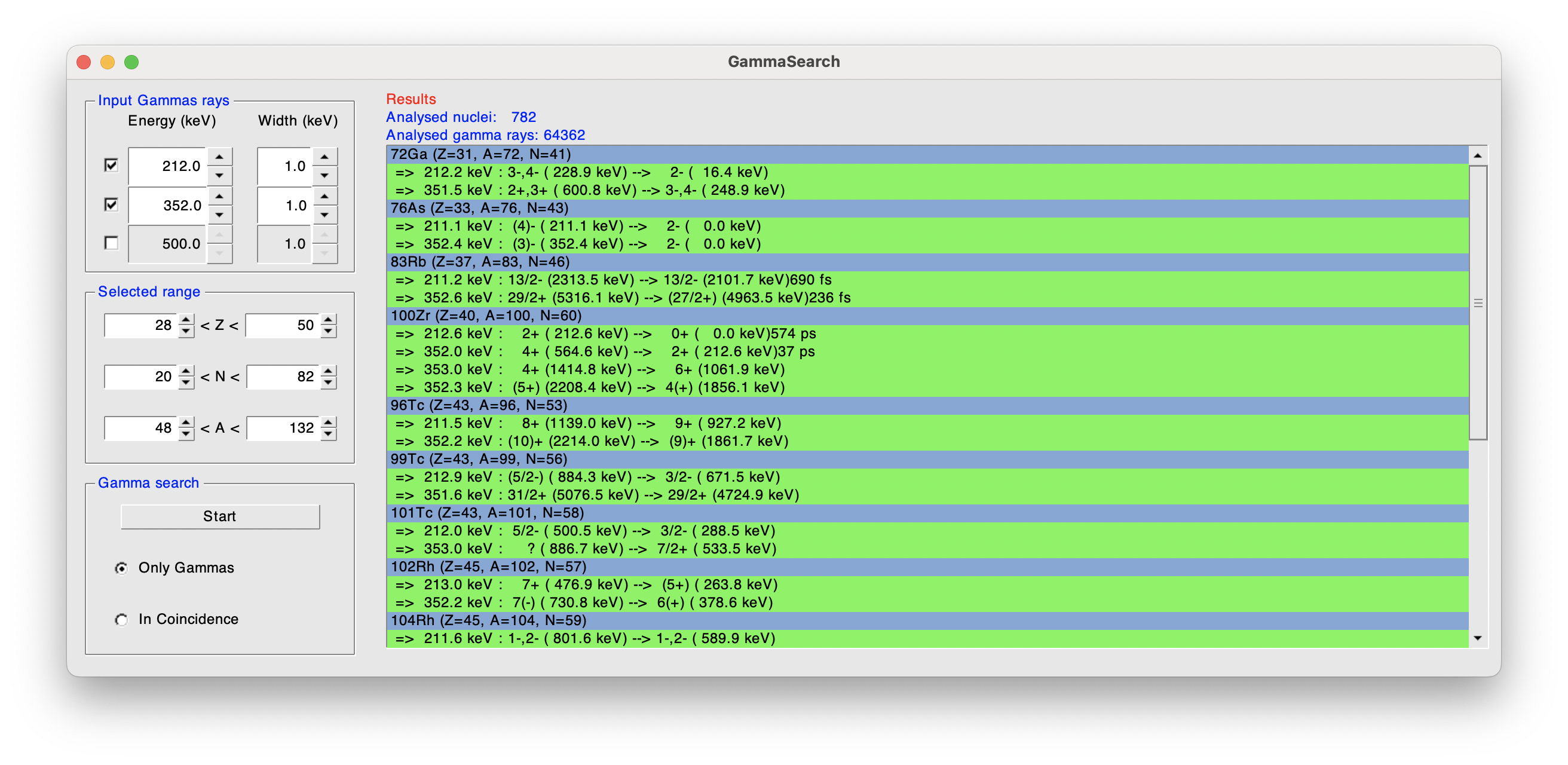
The full list is printed, giving for each nucleus all possible transitions corresponding to the request, sorted as a function of the parent level energy.
It is then possible to add the constraint that these transitions need to be in coincidence in the level scheme:
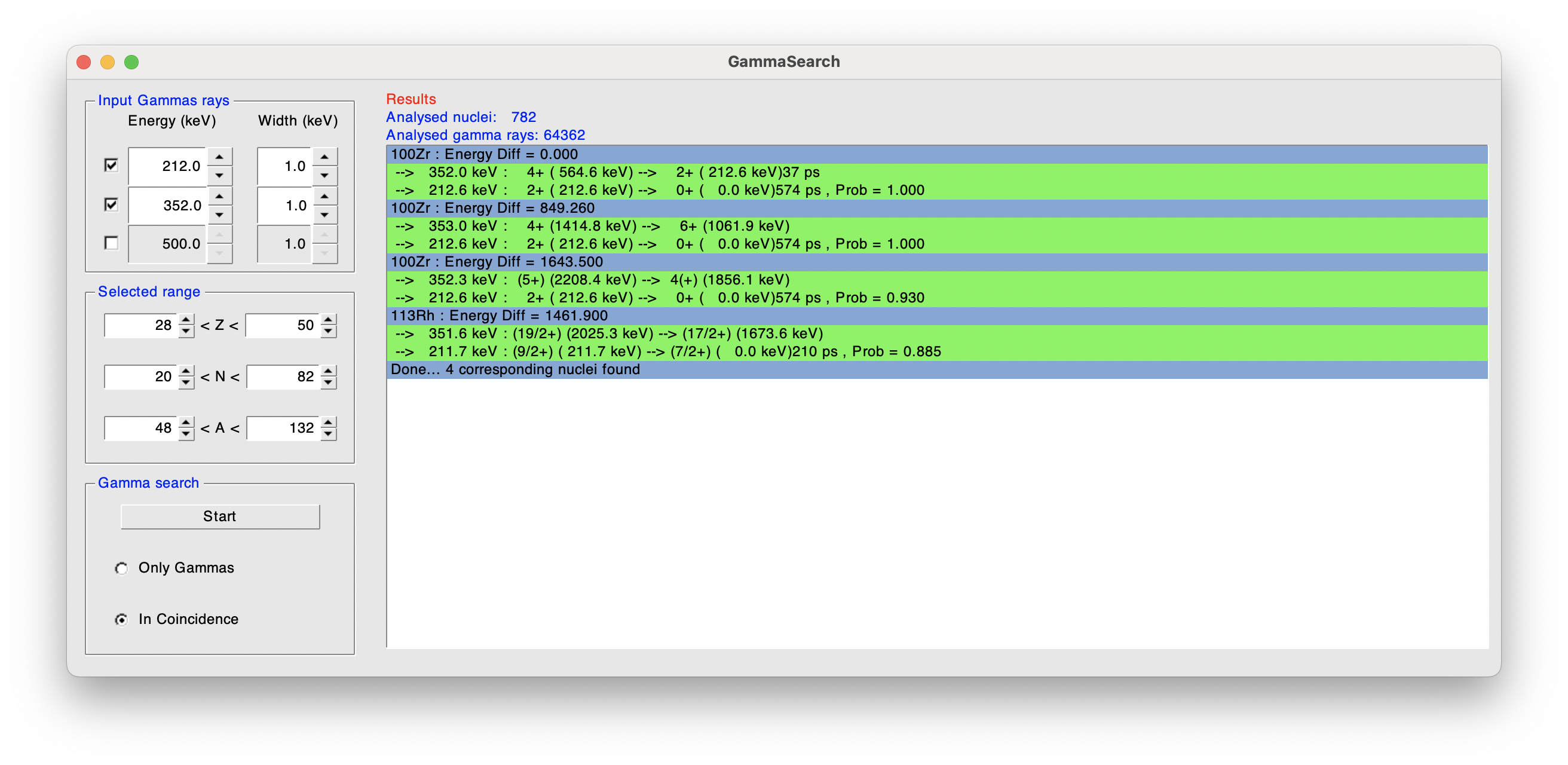
The list of possibilities is clearly shorter with this condition. An important point here is that for each given case, a probability factor is given. This probability factor is calculated as the successive branching ratio from the upper transition to the lower one. A probability of 1 means that, according to the database, all the decays corresponding to the higher excitation energy will go through the lower decay. The results are sorted, first by probability value, and then by the energy difference between the daughter level of the upper decay and the parent level of the lower decay. An energy difference of 0 means that the two decays are directly connected in the level scheme.
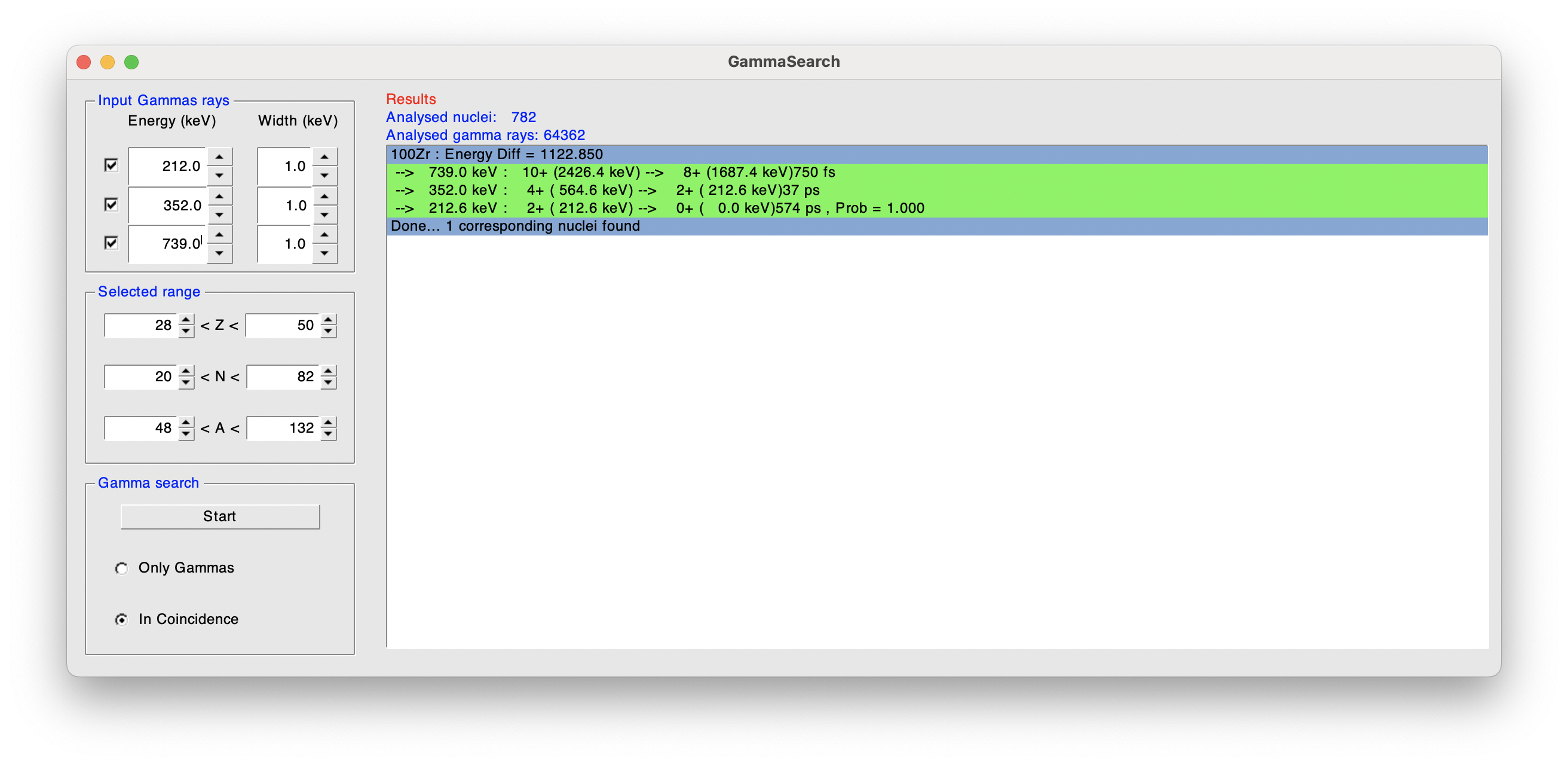
Finally, one can also ask for three decays in coincidence, adding in the following example the energy of the \(10^{+} \rightarrow 8^{+}\) transition in 100Zr:
Interpretation#
The search result is a database-driven hypothesis list, not a unique identification. The most relevant candidates are usually those with:
- small energy differences,
- high probability factors,
- compatible Z and N ranges,
- transitions already expected from the experimental reaction or selection.